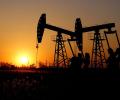
The government has cut windfall gains tax on domestically-produced crude oil to nil while continuing the rate at zero on the export of diesel and ATF. The government has slashed the special additional excise duty (SAED) on crude oil produced by companies such as Oil and Natural Gas Corporation (ONGC) to nil from Rs 4,100 per tonne with effect from Tuesday, an official order dated May 15 said. This is the second time that the levy, which was introduced in July last year in the form of a cess to tax supernormal gains of oil producers and fuel exporters, has been cut to nil for domestically-produced oil.
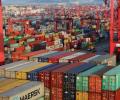
Though the government has been pushing for exports of high-value manufactured goods across major markets in place of raw materials and input goods, India's top exports to China remain in the raw materials category.

The key reason for the country's stagnating exports is its failure to build a strong manufacturing base, says T N Ninan.

Trade deficit during the month narrowed to $17.4 billion as against $12.72 billion in the same month last year
Imports too dipped by 23.1 per cent to $25.41 billion in the month under review as against $33 billion in April 2015.

India's exports grew marginally by 0.88 per cent.
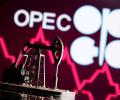
Changes in global oil and gas rates matter more to India's economy than other major economies because the country imports around 87 per cent of its oil, half of its gas in the form of LNG, and over 60 per cent of its LPG.

The kingdom, the world's leading oil producer, also offered to coordinate with the Organisation of Petroleum Exporting Countries and other major producers to ensure adequate fuel supply in order to curb prices. Pressure is being mounted on OPEC, the supplier of more than a third of the world's oil, to boost output in order to ease the effect of high prices on economies across the world.

A combination of externalities such as global trade wars and slowing growth, continuing glitches in accessing offsets under the GST regime, which has created a liquidity crunch for smaller exporters, and the growing competitiveness of smaller countries are causing the slowdown.

Removal of this status means India can now enhance customs duties to any level on goods coming from Pakistan.
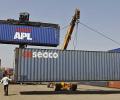
With exporters' claim for over five months still pending, liquidity has been wiped out and the process of finalising new contracts has been held up.
OPEC expects an additional daily average output growth of 1.2 million barrels or a daily average oil output of 87 million barrels in 2008. The OPEC output quota this year will be less than 32 million bpd and non-OPEC output would be about 50.3 million bpd, according to a report . OPEC's actual production will be higher than the quota but that will not be sufficient to coverup the demand-supply imbalance in the international market.

Exports dipped for the 14th month in a row.
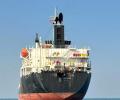
'If attacks escalate, there is a risk the Suez Canal may be closed.'

Oil prices jumped nearly $3 a barrel and gold and safe-haven bonds rallied on Friday after the killing of top Iranian commander Qassem Soleimani in an airstrike by the US in Baghdad.

Prime Minister Narendra Modi on Friday received Bhutan's highest civilian award, the 'Order of the Druk Gyalpo', making him the first foreign Head of the Government to receive the honour.
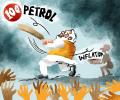
After Rajasthan, Madhya Pradesh and Maharashtra, petrol price has crossed the Rs 100-per-litre mark in Leh, in almost all districts of Andhra Pradesh and parts of Telangana after fuel prices were again hiked on Friday. Petrol price was increased by 27 paise per litre and diesel by 28 paise a litre, according to a price notification of state-owned fuel retailers. The hike - 18th in the last one month - took fuel prices across the country to a historic high. In Delhi, petrol hit an all-time high of Rs 94.76 a litre, while diesel is now priced at Rs 85.66 per litre.

Indian companies place orders worth $600 million for US crude, which is likely to increase by nearly $2 billion in the near future.
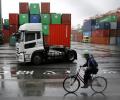
Gold imports, however, grew 10.47 per cent to $ 2.42 billion in May.

Some of these nations are India's biggest export market. India is also dependent on these countries to meet its energy needs.

The shift comes as the gap between the international benchmark Brent and the Middle East price marker narrows
Aramco Trading Co, a subsidiary of state oil giant Saudi Aramco, offered 2.8 million barrels of ultra low sulphur diesel for loading in late July to early August

Indian Oil Corp is ranked highest at 161st in the Fortune 500 list.

oil market remained under pressure and big gains are unlikely.

Stocks of Hindustan Petroleum Corporation Limited (HPCL), Bharat Petroleum Corporation Limited (BPCL) and Indian Oil Corporation Limited (IOCL) have more headroom left despite the sharp run in the last few weeks, suggests a recent report from Morgan Stanley. Stocks of these oil refining and marketing companies (OMCs), it believes, are seeing multiples re-rate as investors reassess long-term growth prospects. "IOCL trades at one year forward P/BV of 1.2x, 19 per cent below +1 standard deviation (SD); BPCL trades at one year forward P/BV of 1.5x, near historical averages; HPCL trades at one year forward P/BV of 1.5x, near +1SD," Morgan Stanley said.
The country's exports jumped by 60.29 per cent to $34.45 billion in March even as the outbound shipments contracted by 7.26 per cent during the full 2020-21 fiscal to $290.63 billion. Imports too grew by 53.74 per cent to $48.38 billion in March, but dipped by 18 per cent to $389.18 billion during April-March 2020-21, according to the government data released on Thursday. Trade deficit during March 2021 widened to $13.93 billion from $9.98 billion in March 2020.
Despite discounts on Russian crude oil - which fell to the lowest since the Ukraine war began - and the rising sanctions, import volumes from the country will remain stable for now or at least till July, said refinery officials. "There is an appetite for Russian crude, and shipments are not expected to taper off beyond this point unless something major happens. "Talks are on, and buying will continue," an official at a major refinery said.
Rising production from OPEC as well as the US also weighing on prices
Exports may fall below $300 bn by 2015-16 end.
Prices are sustainable and not just driven by speculative gains

The country's current account deficit is likely to hit a three-year high of 1.8 per cent or $43.81 billion in FY22, as against a surplus of 0.9 per cent or $23.91 billion in FY21, a report said on Thursday. According to an assessment by India Ratings, the Current Account Deficit (CAD) has moderated to $17.3 billion or 1.96 per cent of GDP in the fourth quarter of FY22 as against $8.2 billion or 1.03 per cent in the year-ago period, and massively down from $23.02 billion or 2.74 per cent in Q3, which was a 13-quarter high. The improvement in the key numbers are due to the remarkable improvement in merchandise exports in FY22, when it grew 42.4 per cent as against a negative 7.5 per cent in the pandemic-hit FY121.
Oil fell below $59 a barrel for the first time since May 2009 on Tuesday, extending a six-month selloff as slowing Chinese factory activity and weakening emerging-market currencies added to concerns about demand.
The declining exports would have implications for the job market.

American refiners closed some of their production, leading to futures trade benchmarked to the West Texas Intermediate going negative.

The Indian Navy, which regards itself as the 'net security provider' in the Indian Ocean Region, has also stepped up to the plate, with a warship stationed at all times off the Gulf of Aden for counter-piracy tasks. 91 Indian warships have been deployed in the region since 2008, patrolling high risk areas where piracy was rampant.

"At the moment, the fall is arrested (and it) is very clear. The growth is happening. We will only be looking at the steady growth. It may be slow but steady," Commerce Minister Nirmala Sitharaman told reporters in New Delhi.
The government is considering a ban on export of kerosene oil (jet kero) and aviation turbine fuel (ATF), which are similar to kerosene, to boost supplies of kerosene for public distribution system.

Imports too jumped by 51.5 per cent to $40.4 billion in July against $26.6 billion in the same period last year, leaving a trade deficit of $11 billion, the Commerce Ministry said on Thursday.

Crude oil has fallen about 40 per cent since mid June and the price on Monday touched its lowest level since mid 2009 before US oil prices posted their biggest one-day gain in two years overnight.

Stocks of the country's bigger tile and ceramic makers were major gainers over the past week. The leaders in this space -- Kajaria Ceramics and Cera Sanitaryware -- were up 7 per cent each. In the past three months, Kajaria Ceramics and Somany Ceramics were up 29-32 per cent, while Cera Sanitaryware gained 22 per cent.
 © 2026 Rediff.com - Advertise with us - Disclaimer - Privacy Policy - Sitemap - Feedback - About us - Terms of use - Grievances